- Careers
- Media & Events
- Downloads
-
- Europe
- Belgium
- Germany
- United Kingdom
- France
- Norway
- Austria
- Switzerland
- Czech Republic
- North America
- Canada
- USA
- Middle East & Africa
- United Arab Emirates
- Saudi Arabia

22.11.2026 | Press Release
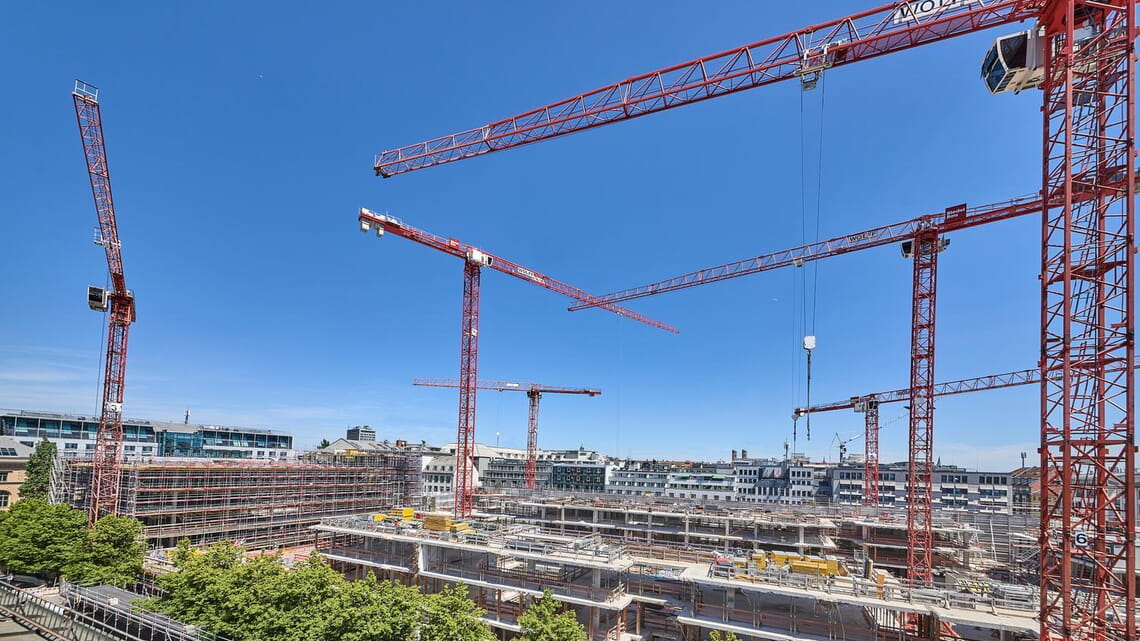
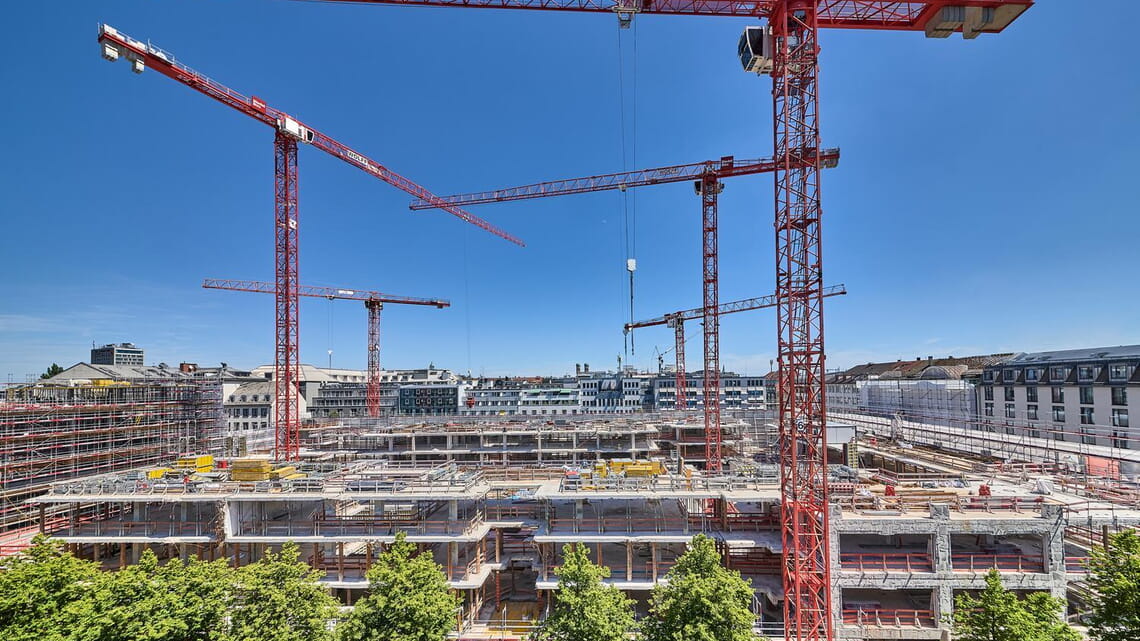
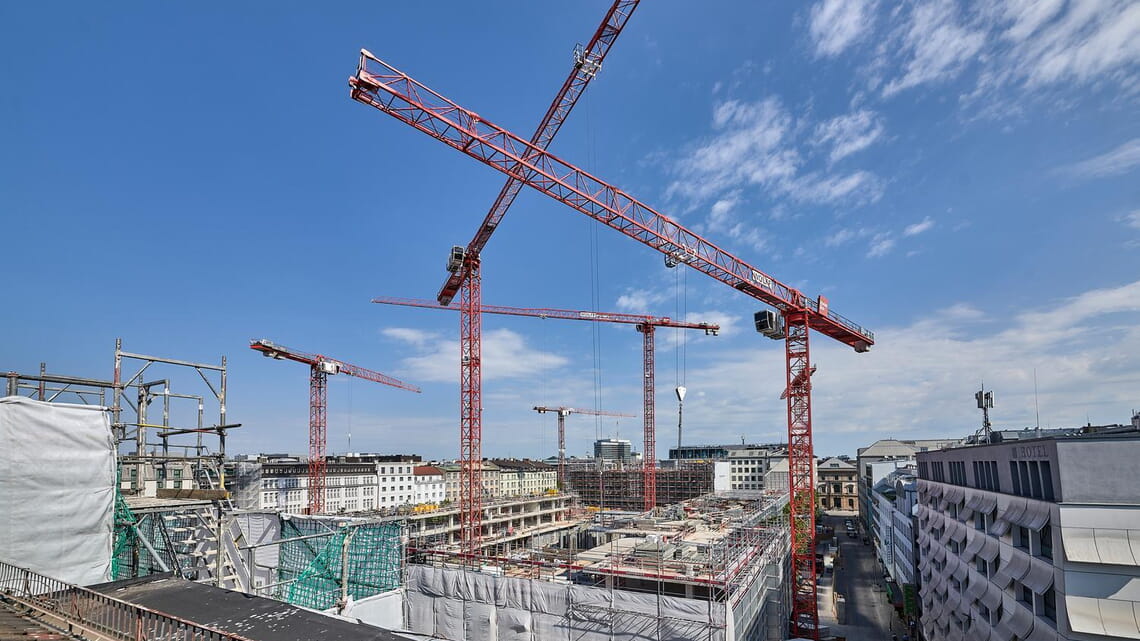
Close to Munich Central Station, the former Postbank-Karree is undergoing a comprehensive revitalization and will be transformed into “The Verse”, a modern Business district, by the end of 2028. Since 2025, six flat-top WOLFF cranes have been supporting the parallel demolition and new construction work on this inner-city site on behalf of Riedel Bau AG, mastering confined space, varying foundation conditions and constantly changing site conditions. “The Verse” exemplifies a trend in the construction industry: building within existing structures conserves resources and
saves CO2, but places high demands on site logistics. Together with Riedel Bau, Wolffkran has implemented a tailor-made tower crane concept for the Munich construction site.
For the demolition and structural work, Riedel Bau is using three rental cranes and three cranes from its own equipment fleet, including the new WOLFF 8038.20 Clear purchased specifically for this project – the largest flat-top trolley jib crane in the WOLFF portfolio. Positioned in the center of the site, it handles the central site logistics together with a WOLFF 7534.16 Clear. With its 75-meter jib, it can lift 4.7 tons at the tip and a maximum of 20.0 tons. Both cranes lift reinforced concrete sections of up to twelve tons cut out of the existing structure, and transport three-cubic-meter concrete buckets and precast elements weighing up to eight tons to where they are needed.
The two large WOLFF cranes are supported by two WOLFF 7032.12 Clear, one WOLFF 6015.8 Clear and one WOLFF 6031.8 Clear, positioned at the edge of the site. During their deployment until May 2027, they will together move around 10,000 tons of demolition material, 5,000 tons of steel and 35,000 cubic meters of concrete.
A pack between demolition and structural work
A particular challenge when building within existing structures is that crane locations cannot be chosen freely, as they can for a new build; instead, the cranes have to fit into the existing building structures. All six WOLFF cranes were therefore installed on cross frames, which allow flexible adaptation to the respective ground conditions and targeted transfer of the crane loads. While the two large cranes stand on existing floor slabs and foundation slabs respectively, individual foundation solutions had to be found for the four cranes at the edge of the site. The WOLFF 6015.8 Clear was founded on bored piles. The two WOLFF 7032.12 Clear stand partly on existing basement walls and are additionally supported on cast-in-place concrete foundations and micropiles respectively. For the WOLFF 6031.8 Clear, the cross frame was positioned on a newly constructed building wall and a pad foundation, so that the crane loads could be routed around existing underground utility lines. All four locations of the outer cranes had to be closely coordinated with the municipal authorities and utility companies. An added challenge was positioning them, despite existing building edges, so that they could optimally cover all working areas.
Because of the existing buildings, the cranes sometimes have to lower their loads up to five floors deep into existing building shafts and access openings, and existing building edges make crane operation even more demanding. The location right next to Munich Central Station is also a challenge for the entire site logistics: as there is hardly any storage space on site, both the removal of demolition material and the delivery of building materials have to be closely coordinated with the ongoing work.
Five cranes were erected with the help of mobile cranes, while the WOLFF 8038.20 Clear erected the WOLFF 6015.8 Clear and will also dismantle it, along with one WOLFF 7032.12 Clear. The two large cranes in the inner site area were originally erected from the inner courtyard – something that will no longer be possible during dismantling because of the newly constructed building. They will therefore be dismantled using a 450-ton mobile crane with a luffing jib that reaches over the new building edges. “We work closely with Wolffkran, especially when planning crane erection and dismantling,” says Daniel Martinas, Work Preparation, Riedel Bau AG. “What we value about our partner is not only the clearly structured crane portfolio, but also the consistently well-thought-out, individual solutions – especially for demanding projects like this one.”
Building Within Existing Structures – A trend with a future
Designed by the architectural firm Herzog & de Meuron, “The Verse” will offer a total gross floor area of around 76,000 square meters for offices, dining, retail and other uses. It exemplifies an international construction trend in which buildings are comprehensively redesigned rather than newly built. By integrating large parts of the existing building structure into the new development concept, a considerable share of so-called “embodied energy” is saved – energy that would otherwise be needed to produce new building materials and components. Wolffkran is currently also involved in a similar transformation project in London. Nine WOLFF cranes are being used for the redevelopment of the 1 Victoria Street office complex, some of them standing on existing foundations more than 60 years old with individually adapted cross frames.
| Crane type | Crane base | Jib radius (m) | Max. load capacity (t) |
|---|---|---|---|
| WOLFF 8038.20 | Cross frames | 75.0 | 20.0 |
| WOLFF 7534.16 | Cross frames | 60.0 | 16.5 |
| WOLFF 6015.8 | Cross frames | 50.0 | 8.5 |
| WOLFF 7032.12 | Cross frames | 35.0 | 12.0 |
| WOLFF 7032.12 | Cross frames | 40.0 | 12.0 |
| WOLFF 6031.8 | Cross frames | 40.0 | 8.5 |