- Careers
- Media & Events
- Downloads
-
- Europe
- Belgium
- Germany
- United Kingdom
- France
- Norway
- Austria
- Switzerland
- Czech Republic
- North America
- Canada
- USA
- Middle East & Africa
- United Arab Emirates
- Saudi Arabia


23.07.2026 | Press Release
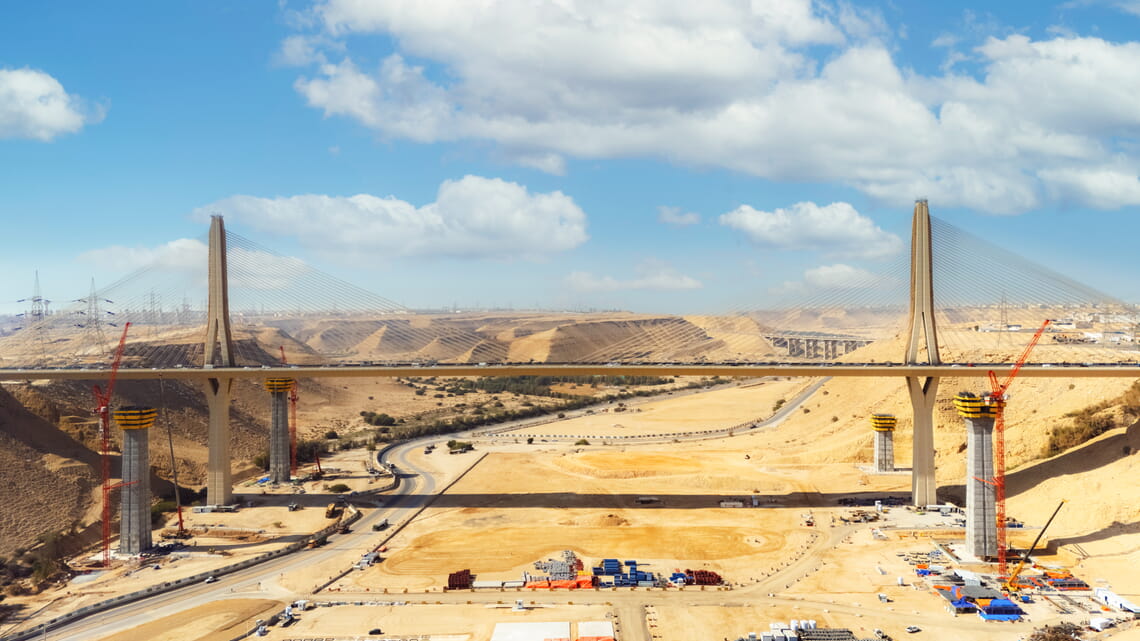
Riyadh, Saudi Arabia – May 2026. For over 30 years, the Wadi Laban Bridge was the only crossing of the valley of the same name in the southwest of Saudi Arabia’s capital, Riyadh. Now, the existing crossing is being complemented by two new cable-stayed bridges, which are being constructed on both sides of the current bridge.
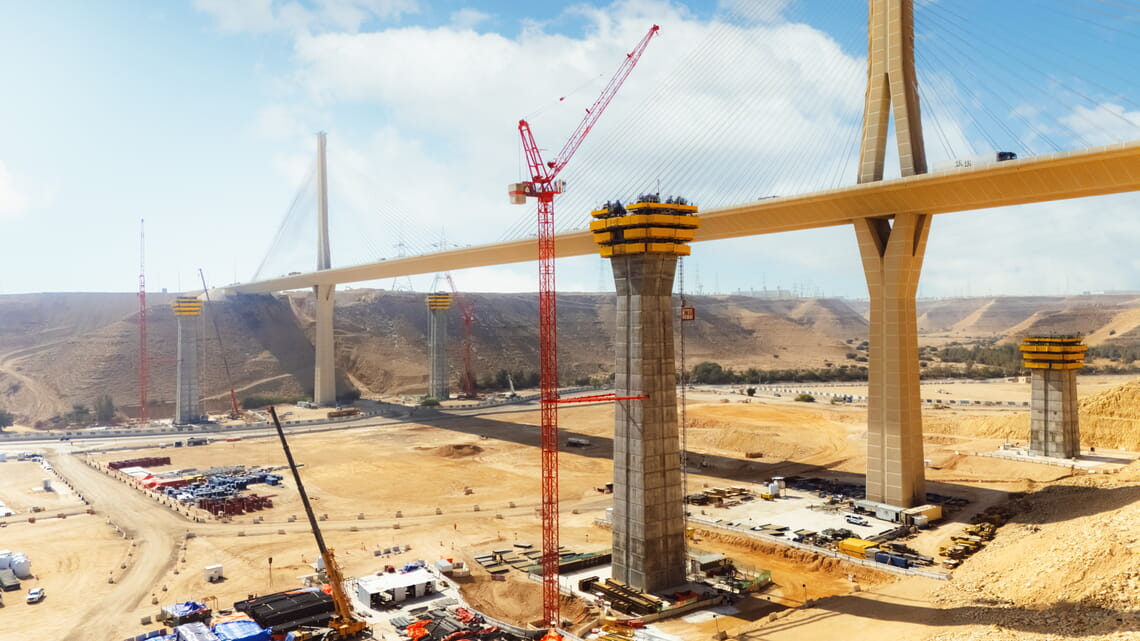
The client is the Royal Commission for Riyadh City, and the project is being executed by the ICRC joint venture consisting of the Turkish construction company ICTAS and the Al Rashid Trading & Contracting Company (RTCC) from Riyadh. At the major construction site in the middle of Riyadh’s desert landscape, three WOLFF 180 B luffing jib cranes are being used, handling all lifting tasks – from formwork and reinforcement to concrete placement.
The three “WOLFF” cranes, each equipped with 40-meter jibs, reach a hook height of 157 meters and have a maximum lifting capacity of 18 tons. They are being used to construct four bridge pylons, which are up to approx. 170 meters high, and handle formwork systems, and transport reinforcement, as well as carrying out concrete pouring. In addition, they lift work platforms, surveying equipment, and other construction site gear. A particular challenge was the simultaneous repositioning of several stacked working platforms when changing the formwork between different pylon sections during which they fully utilized their maximum load capacity of 18,0 tons. As construction progresses, the cranes will also lift support beams weighing up to 12,0 tons for the concreting of the pylon heads.
Gigantic structures for improved mobility
The three WOLFF 180 B luffing jib cranes were assembled in 2025 using mobile cranes and are expected to remain in operation on the construction site until approximately 2027. Once completed, the two new cabled-stayed bridges will each have a total length of around 763 meters and a main span of 405 meters. With a width of about 35 meters, they are designed for a total of eight traffic lanes and will significantly increase the capacity of this important arterial road in Riyadh. The new construction is part of the “Main and Ring Road Axes Development Program,” a comprehensive expansion initiative for the capital’s main traffic routes.
| Crane type | Crane base | Jib radius (m) | Hook height (m) | Max. load capacity (t) | BGL Group (tm) |
|---|---|---|---|---|---|
| WOLFF 180 B | Foundation anchor | 40.0 | 157 | 18 | 180 |
| WOLFF 180 B | Foundation anchor | 40.0 | 157 | 18 | 180 |
| WOLFF 180 B | Foundation anchor | 40.0 | 157 | 18 | 180 |